Reliably dissipate waste heat from IGBTs and MOSFETs.
Power semiconductors generate waste heat. If this heat is not dissipated, component temperatures can rise above the permissible range.
Water-cooled heat sinks dissipate this heat directly into a liquid medium via a cooling plate. This medium efficiently transports the heat out of the system.

You get everything from simulation to final testing from a single source. No external testing service provider is needed

Vacuum brazing, FSW welding, drilled profiles, and radiators with tube coils. Miba selects the technology that best suits your application.

Miba manufactures according to your drawings or develops a cooling solution based on your specifications.
Air cooling works until the heat load becomes too high or the installation space becomes too small.
Water-cooled heat sinks transfer heat much more efficiently because the cooling medium has a higher thermal capacity than air.
The choice of cooling technology depends on thermal requirements, installation space, and environmental conditions. This overview helps you make an initial assessment.
| Air cooling | Liquid cooling | |
| Heat dissipation under high thermal demands | Limited | Suitable |
| Installation space | Larger | Compact |
| Coolant | Air | Pure water or water-glycol mixtures |

Have the requirements reviewed.
Miba manufactures water-cooled heat sinks using four different technologies. The choice depends on your requirements regarding, for example, heat dissipation, cooling medium, and installation space.
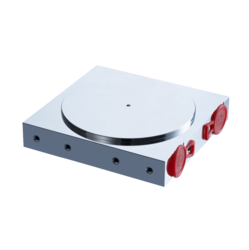
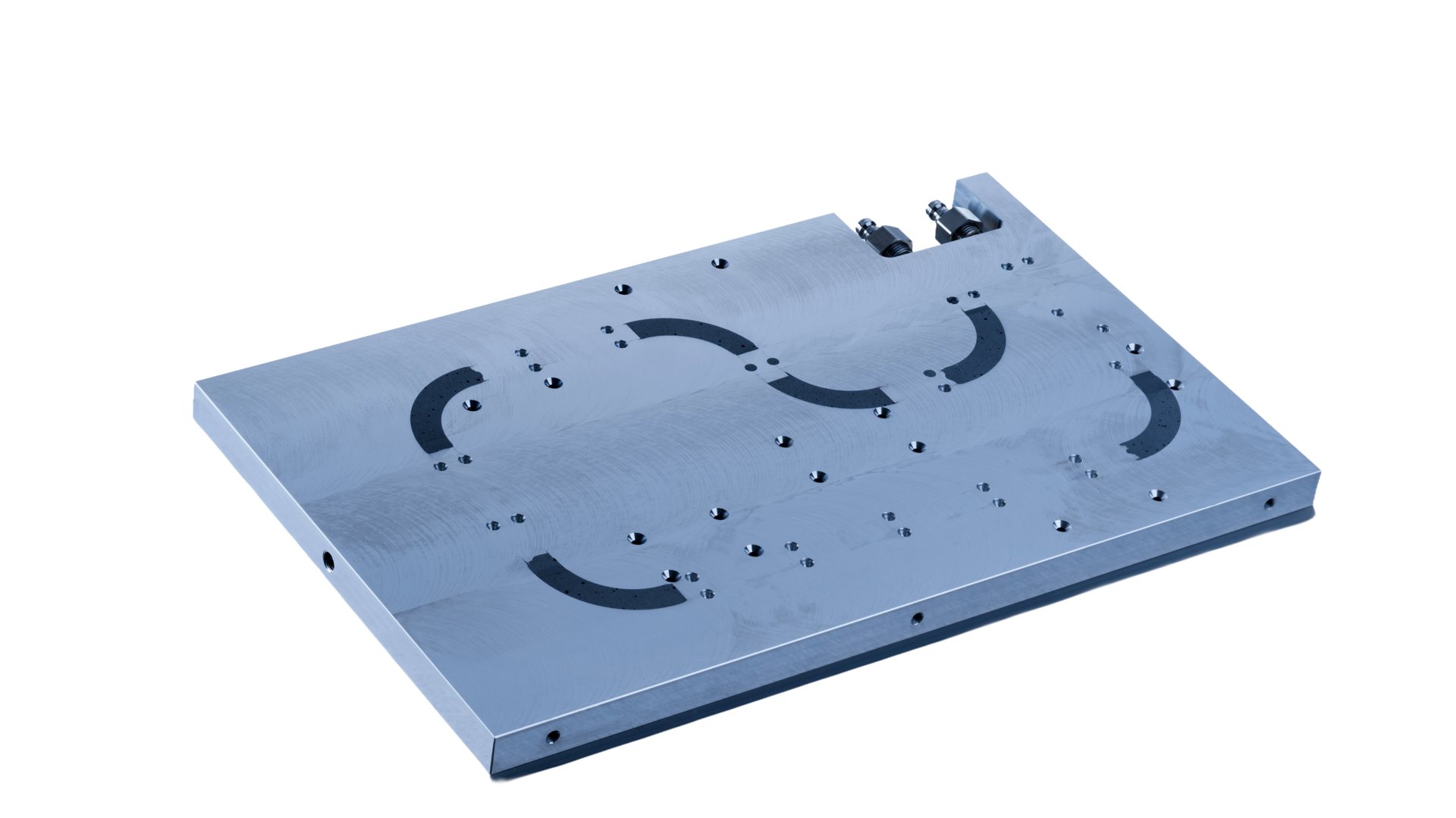
Vacuum-brazed cooling plates enable precisely milled internal structures with minimal thermal resistance. They are suitable for applications with the most demanding requirements for cooling performance, leak tightness, and explosion resistance, such as IGBT, IGCT, and SiC MOSFET semiconductor modules.
Burst pressure up to over 3,650 psi (over 250 bar), no flux required, minimal warpage.
Download: Product Data Sheet VBA
FSW cooling plates join the base body and cover plate without melting the material. This reduces warpage and porosity. Custom channel geometries can be manufactured with consistent results. They are suitable for applications with high cooling performance requirements.
Suitable for, among others, IGBTs and MOSFETs in inverter, traction, and power applications.
Friction Stir Welded (FSW) Water-Cooled Heat Sinks FSW cooling plates join the base body and cover plate without melting the material. This reduces warpage and porosity. Custom channel geometries can be manufactured consistently. They are suitable for applications with high cooling performance requirements. Suitable for, among others, IGBTs and MOSFETs in inverter, traction, and power applications.
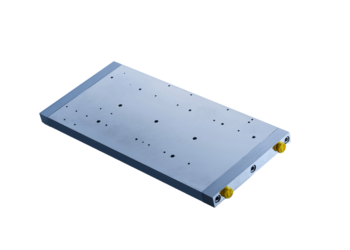
Drilled water-cooled heat sinks are manufactured from aluminum profiles with customer-specific dimensions and water channels.
Suitable for IGBTs and high-power resistors, among other applications.
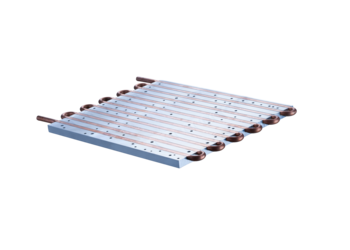
Tubed cold plates consist of copper or stainless steel tubes embedded in an aluminum base plate.
Suitable for applications with special fluid or corrosion requirements.

Miba manufactures water-cooled heat sinks in two ways:
The Solution Team supports the entire process: CFD simulation, design, manufacturing, and testing (such as IGBT testing, helium leak testing, pressure drop testing, IR imaging, and mechanical validation).
Talk to the Solution Team!
Depending on requirements, each water-cooled heat sink can undergo a defined test program prior to shipment. Miba can test thermal performance, leak tightness, and mechanical strength in its own testing facility.
Water-cooled heat sinks are used in applications where power electronics must remain within the permissible temperature range at all times.
Every project is unique, so it’s not possible to give a general estimate of the development time.
It depends, among other things, on the technical complexity, the specifications, and the desired validation steps. As soon as we know your requirements, we’ll evaluate them together with our Solution Team and provide you with a well-founded estimate, taking your project timeline into account, of course.
After receiving your requirements, we analyze them together with our Solution Team and provide an initial assessment regarding technical implementation, development effort, and a potential project timeline.
Yes. Miba manufactures prototypes as well as small and large batches. The quantity is taken into account during the design phase.
The test procedures used—including IGBT testing, bubble testing, helium leak testing, pressure loss testing, and mechanical validation—follow defined test plans.
The Solution Team will determine which test procedures are relevant to your application as part of the project specification.
Depending on the application, a combination may be appropriate. Miba evaluates which technology or combination delivers the best thermal performance based on your specific requirements.
Yes. Based on an existing drawing or specification, Miba can develop and manufacture an equivalent or optimized cooling plate.
Available surface treatments depend on the material and the application. The Solution Team is available to assist with specific requirements.