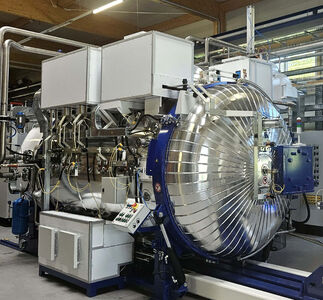
Efficient aluminum cooling systems are crucial for the service life and reliability of modern equipment. Two processes play a central role in joining these heat sinks:
While friction stir welding is well established in many areas, it has a clear disadvantage when it comes to complex heat sinks: the point connection.
Vacuum brazing offers significant advantages for applications that require absolute leak-tightness and uniform heat transfer. Only a few suppliers in various segments across Europe have mastered this process, including us at Miba Cooling.
In this article, we show
• why vacuum brazing is the more sensible alternative to friction stir welding for heat sinks.
• how it works.
• what technological and sustainability advantages it offers specifically for aluminum cooling systems.
In friction stir welding (FSW welding), two aluminum parts are joined together under pressure using a rotating tool. The friction generates heat, causing the material to become plastic and “stir” along the weld seam. The result is a stable, mechanical connection.
This process is ideal for load-bearing components. However, friction stir welding reaches its limits when it comes to heat sinks with fine channels and extremely high thermal requirements:
FSW is hardly economically viable, especially for complex, multi-layer cooling structures or finely milled flow channels.
In vacuum brazing, the aluminum components are heated to around 600 °C in a closed furnace under vacuum. This causes them to fuse together metallurgically, without any additives or weld seams as in friction stir welding.
The decisive advantage lies in the full-surface connection: the components are not joined at specific points, but across their entire contact surface.
The result is a homogeneous, absolutely dense, and thermally conductive unit. Coolants cannot escape, and heat transfer is evenly distributed across the entire component. This surface connection makes vacuum brazing ideal for complex aluminum heat sinks.
Another advantage is the high degree of design freedom: even fine flow channels, multi-layer cooling structures, or complex geometries can be realized. Since there is no mechanical stress from a tool, the sensitive milled structures inside the heat sink remain completely intact.

Since the connection is made over the entire surface and is stress-free, and no additives are required, there is hardly any distortion of the component. This shortens post-processing times and minimizes testing effort. For manufacturers, this means lower production costs, stable processes, and reliably high product quality.

In modern companies such as Miba Cooling Austria, the waste heat generated during soldering is used to heat the entire site. In combination with photovoltaic systems, this creates a virtually energy-self-sufficient production process.
| Friction stir welding | Vacuum brazing | |
| Connection type | Mechanical, selective using rotating tool | Full surface under vacuum |
| Tightness | Seam-dependent, potentially prone to pores | 100% leak-proof thanks to flat connection |
| Thermal conductivity | Locally limited by seam zones | Evenly across the entire surface |
| Geometric freedom | Limited by tool shape | Freely configurable, ideal for complex cooling structures |
| Process reliability | Tool-dependent, limited repeatability | Fully automatable, reproducible |
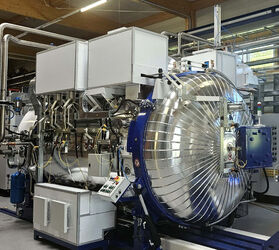
Miba Cooling Austria in Ligist has been successfully using vacuum brazing for 15 years to manufacture high-performance aluminum cooling systems for applications ranging from offshore wind farms to medical technology. Four vacuum brazing furnaces with different capacity ranges are available for this purpose.

“The full-surface bond prevents coolant from leaking out. This is one of the biggest advantages of heat sinks over processes such as friction stir welding.”
- Martin Reisner, Managing Director of Miba Cooling -
Learn more about how vacuum brazing can take your cooling technology to the next level.
