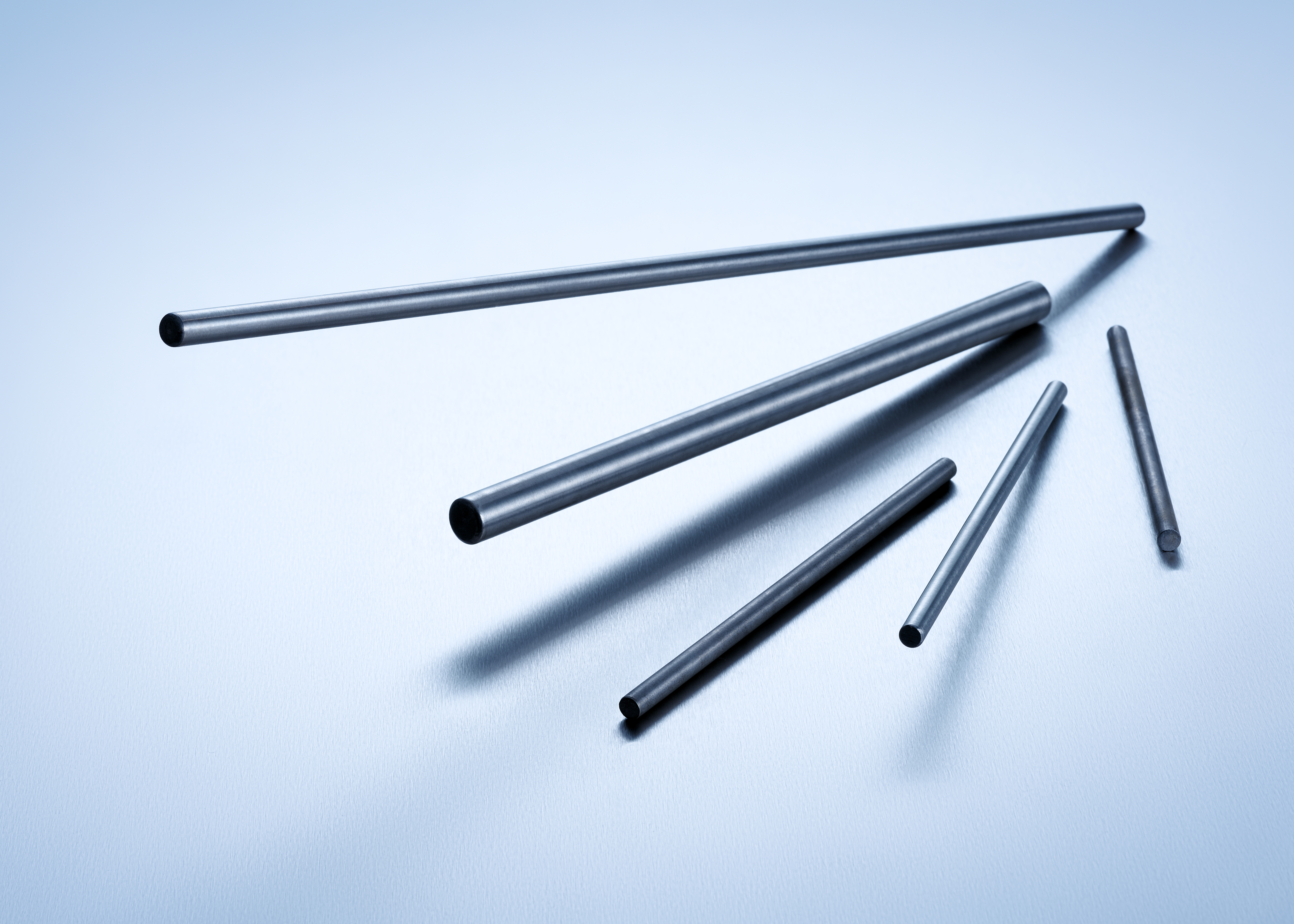
More than 25 times higher thermal conductivity than solid copper
Miba’s heat pipe cooling bridge the gap when air cooling is no longer sufficient and liquid cooling is not an option.
By using vacuum-sealed copper tubes with an internal capillary structure, heat is transported silently and maintenance-free from the hotspot to the cooling surface via a liquid phase change.
Miba supports you with build-to-print manufacturing based on your drawings or with custom designs.

Our heat pipes are available in round, flat or curved designs and can be seamlessly integrated into complex assemblies or cooling towers.

Silent, with no moving parts or coolant. This makes heat pipe cooling a durable and reliable solution.

Our Solution Team supports you with CFD simulations and in-house validation tests. European Footprint.

These technical limitations and requirements may necessitate the use of a heat pipe cooling:

Talk to our experts about your requirements.
Request a consultation now!
Miba's heat pipe cooling are based on proven materials and precise manufacturing parameters to meet the most demanding thermal requirements:
Vacuum-sealed copper tubes with an integrated capillary inner system (coiled structure).
Use of high-purity water or alcohol, selected based on the specific operating temperature.
Standard diameters range from 4 to 18 mm, and standard lengths range from 50 to 750 mm. Custom designs are also available.
Heat pipe cooling are extremely thermally conductive (over 25 times more so than pure copper) with minimal thermal resistance.
Available in round, curved or flat designs, precisely tailored to your system environment.

We guide you through the entire process of developing your heat pipe cooling. With in-house capabilities for CFD simulations as well as thermal and mechanical validation, we deliver “first-time-right” solutions all under one roof.

“Our customers usually come to us with a specific hotspot issue. We integrate the heat pipe heat sinks into the overall system in such a way that the heat ends up exactly where it can be dissipated most efficiently.”
Markus Ettl
Head of Sales Miba Cooling
Tell us about your application. We’ll determine whether our heat pipe coolings are suitable for your application.
Request a consultation!
Heat pipe cooling are used in applications where high heat dissipation is required in a very confined space. This technology is essential across industries for systems that require stable cooling performance without active components or additional infrastructure.
This is particularly useful when space is limited for SiC/GaN modules, this design enables stable cooling performance even in very confined spaces.
In systems with complex geometries, heat pipe assemblies serve as a flexible bridge. They efficiently transfer heat from the source to a remote heat sink.
Embedding heat pipes directly into cooling plates or base structures significantly improves temperature distribution. This prevents localized overheating.
From individual heat pipe cooling to complex thermal assemblies
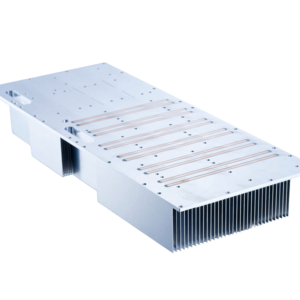
The embedded heat pipe is integrated directly into the structure of the heat sink. This design optimizes local heat absorption at thermal hotspots.
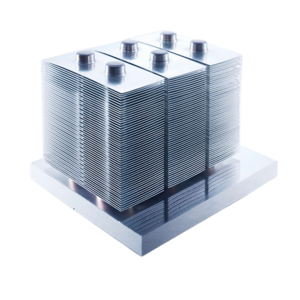
The heat pipe cooling tower serves as a vertically designed, heat dissipation system for modern semiconductors such as SiC, GaN, or IGBT modules. By making efficient use of the vertical space, this design achieves significantly improved thermal performance.
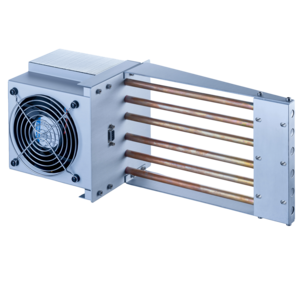
Heat pipe assemblies are fully pre-assembled units that transfer heat from the source to the heat sink without the use of active components. Miba acts as a system partner in this process.
A heat pipe is a thermal transfer component that efficiently transfers heat from a heat source to a cooling area.
The system operates without electricity, requires no pumps and has no moving parts.
Like heat pipes, they utilize the two-phase principle:
In the heating zone, a working fluid evaporates; the vapor travels to the cooler end, condenses there while releasing hea, and flows back to the evaporator via an internal capillary structure (wick).
This closed loop enables continuous heat transfer.
Heat pipes are designed for the directed transfer of heat from point A to point B and can be flexibly routed within a space.
In contrast, vapor chambers are used to distribute heat evenly across a surface in order to create isothermal conditions.
As passive heat conductors, heat pipes achieve an efficiency that is up to 100 times greater than that of solid copper. This enables extremely low thermal resistance with minimal material usage.
Because it does not use mechanical components or external coolants, a heatpipe cooling is virtually maintenance-free and offers a very long service life. The vacuum-tight seal also ensures consistently stable performance.
We manufacture heat pipes in round, flat or curved configurations to ensure they fit perfectly into your system environment. For complex requirements, our experts can assist with the design of custom assemblies or cooling towers.
Yes, thanks in particular to our standardized production pipes, we can efficiently handle even small quantities. For complex, custom assemblies, our experts will be happy to assess feasibility based on your requirements.
Our engineering team supports the entire product lifecycle, from initial design and CFD simulation support through to validation.
In our in-house laboratories, we conduct thermal and mechanical tests to ensure compliance with your specifications.
No. Since it requires neither additional coolant nor external infrastructure, the system is maintenance-free and offers high operational reliability throughout its entire service life.
