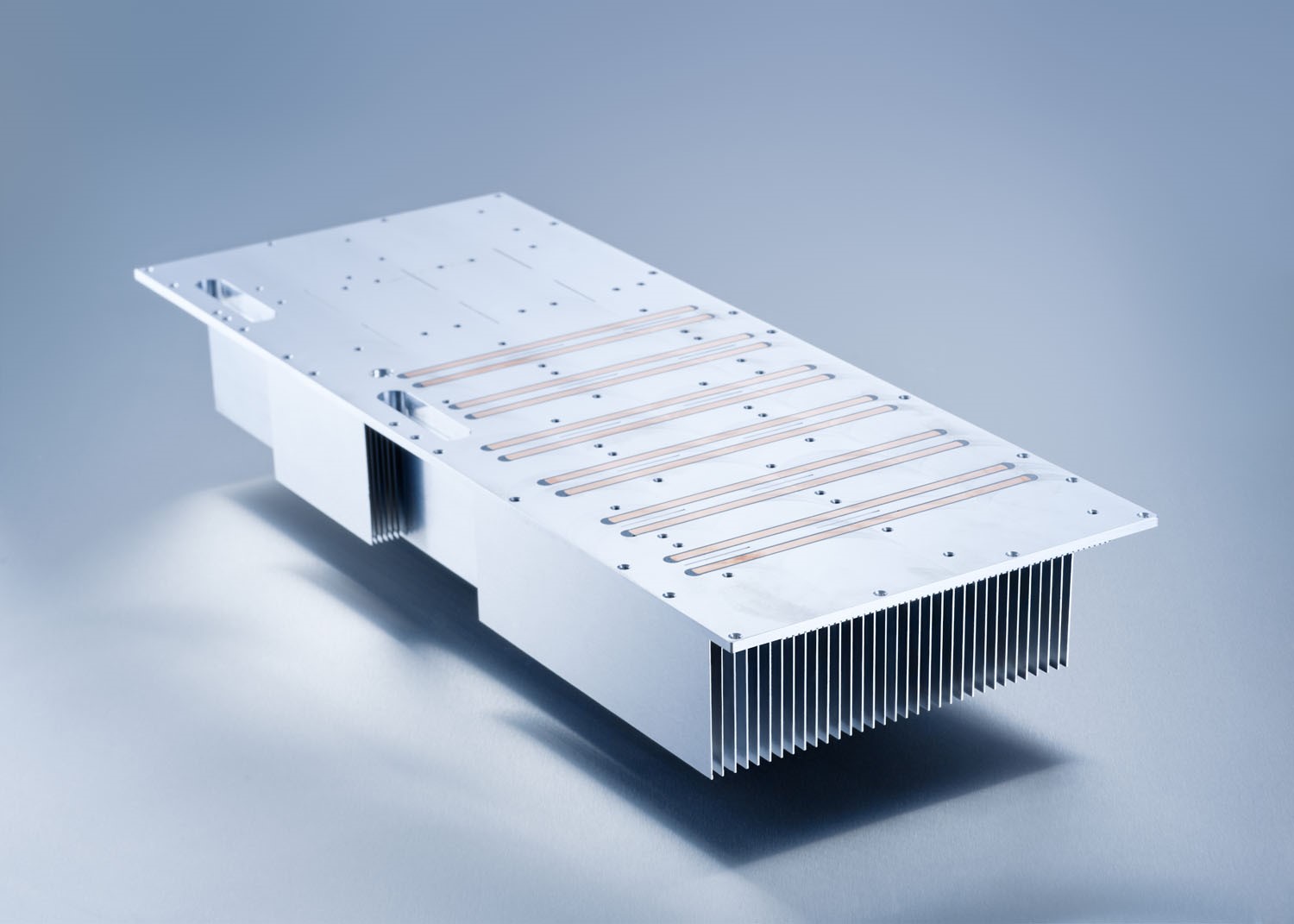
Targeted cooling of hotspots
Localized hotspots beneath SiC, GaN, MOSFET, IGCT or IGBT devices limit power handling and service life. Embedded heat pipes heat sinks solve this problem.
They are integrated directly into the heat sink and transfer heat from the hotspot to cooler areas without requiring external energy or moving parts.
Miba Cooling

Embedded heat pipes are integrated directly into the heat sink. Heat is quickly distributed from local hot spots to larger areas.

No electricity, no pump, no moving parts. The system operates in a closed loop and requires no maintenance.

Miba supports you with CFD simulations, in-house validation tests, and an end-to-end process chain at its own facility.

We'll determine which embedded heat pipe heat sink solution is right for your system.
Request a consultation now!
Miba's heat pipes heat sinks are based on proven materials and are precisely engineered to meet your requirements during the design phase.

Heat pipe heat sinks consist of an aluminum or copper tube with a vacuum-sealed, capillary internal system. Heat is transferred through evaporation and condensation.

Heat pipe heat sinks are available in round, curved or flat configurations, depending on the requirements of the system environment.

Miba supports you with an end-to-end process chain at its own facility, from machining to validation.
Embedded heat pipe heat sinks support hotspot management through two-phase heat transfer with high effective thermal conductivity in the following applications:
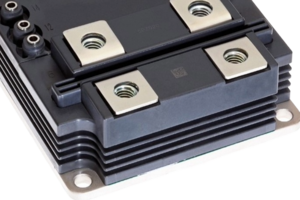
Increasing demands in SiC applications require targeted hotspot management. Embedded heat pipes transport heat from the hotspot to areas where a larger heat sink can effectively dissipate it.

Where liquid cooling is not an option, embedded heat pipe heat sinks provide cooling without the need for additional infrastructure.

They operate without an external power intake. As a result, they are particularly well-suited for applications that demand high reliability and low weight.
From individual heat pipe heat sinks to complex thermal assemblies
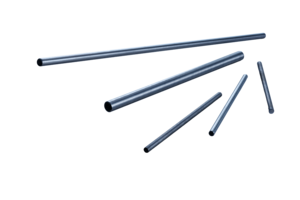
Heat pipe heat sinks fill the gap when air cooling is no longer sufficient and liquid cooling is not an option.
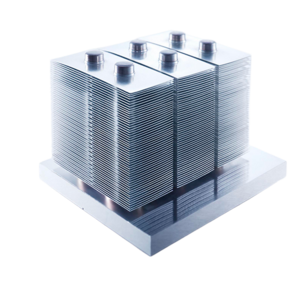
The heat pipe cooling tower is a vertically designed cooling system for SiC, GaN, MOSFET and IGBT modules.
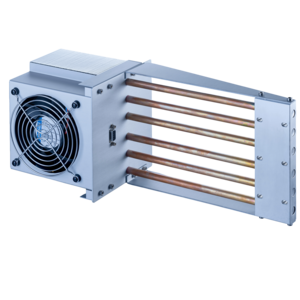
Heat pipe assemblies are fully pre-assembled cooling units. They transfer heat without the use of active components.
Embedded heat pipe heat sinks are heat transfer elements that are integrated directly into a component, such as heat sinks.
They absorb heat locally at hotspots and efficiently transfer it to cooler areas through phase-change processes, entirely without external power intake.
Heat pipe heat sinks are based on the two-phase heat transfer principle.
By integrating it into the component, this highly effective heat transfer is achieved directly at the thermal hotspots. This is particularly effective where purely conductive heat paths reach their physical limits.
If the overall cooling capacity is generally sufficient but local hotspots are limiting efficiency, embedded heat pipe heat sinks are the right solution.
They make better use of the existing cooling surface without increasing the size of the overall system.
Embedded heat pipe heat sinks enable directed heat transfer between localized heat sources and cooler areas. Vapor chambers, on the other hand, distribute heat evenly across a surface and ensure a particularly uniform temperature distribution.
Typical areas of application include systems with high heat loss and locally concentrated hotspots, such as in power electronics, medical technology and aerospace and defense applications.