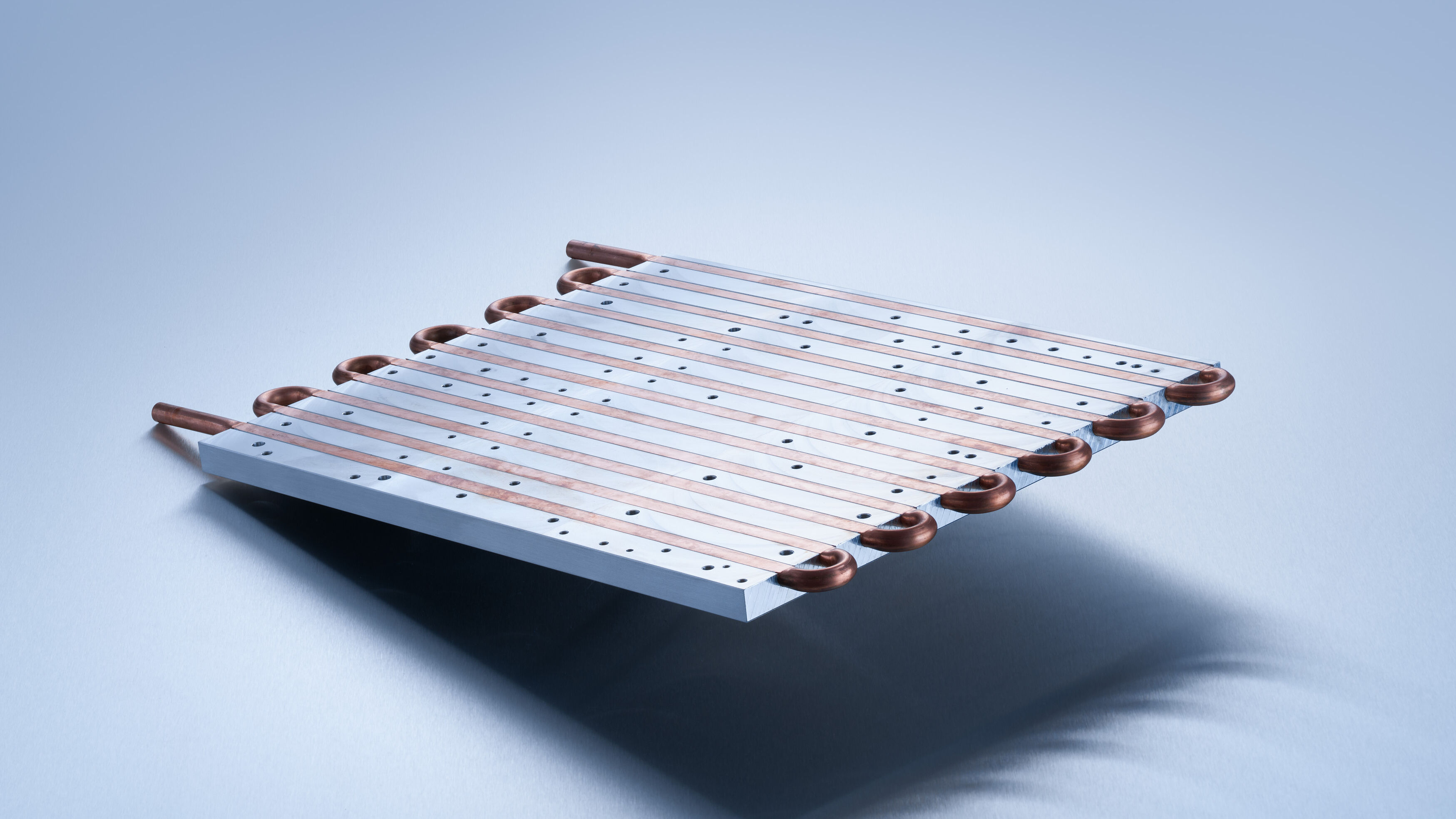
Tubes near the hotspot
A tubed cold plate is a cooling plate designed for liquid cooling. It embeds copper or stainless steel tubes into an aluminum base and dissipates heat generated by power electronics directly into a flowing coolant.
Miba tailors the tube material, tube diameter, tube routing, and base plate to your application. Please let us know your module positions and hotspots. We’ll determine the appropriate design.

Curved and precisely embedded tubes can be routed close to hot spots. This allows heat to be transferred to the cooling medium right where it is generated, tailored to the material requirements of the customer's systems.

Copper or stainless steel tubes can be integrated into aluminum base bodies and tailored to the cooling medium, thermal load and installation space.

Miba supports your project from the design phase through thermal and mechanical validation all the way to production. In-house testing capabilities reduce the number of interfaces and facilitate coordination throughout the project.
Custom-tailored materials and designs enable cost-effective liquid cooling for customer-specific systems in the mid-range cooling capacity category of liquid cooling solutions. Materials, design, and manufacturing must be adapted to the specific customer system as well as to existing specifications and drawings.
Miba considers the following factors during the selection process:

Talk to our experts about your needs.
Request a consultation now!
Tubed cold plates offer a liquid cooling solution for applications with moderate power requirements. The tubing material, tubing layout, and base plate can be specifically tailored to the customer’s system.

Tubed cold plates are suitable for applications that require liquid cooling designed to meet specific needs. Compared to more complex cooling structures, they offer a flexible and cost-effective solution.

The pipe diameter, pipe routing, and cooling medium are tailored to the specific application. This allows pressure loss to be taken into account during the design phase.

Coordinated development, testing, and manufacturing processes can reduce interfaces and facilitate collaboration on projects.
The tubes are typically made of copper or stainless steel. Aluminum plates are usually used as the base plate.
Miba adapts the tube layout, tube diameter, and base plate to the installation space and module positions.
Suitable cooling fluids include water and water-glycol. Depending on the application, deionized or demineralized water can be used.

“A tubed cold plate is a good choice when a high-end solution isn't necessary. This keeps the liquid cooling system flexible and allows you to control the pressure drop.”
- Thomas Pfeiffer -
Head of R&D
Let us know your requirements. We'll determine whether this solution is right for your application.
Request a consultation now!
Tubed cold plates are part of a broad portfolio of liquid cooling solutions. The most suitable technology depends on customer-specific requirements—such as thermal load, coolant, pressure drop, and available installation space. Our Solution Team will be happy to assist you in selecting the right solution.
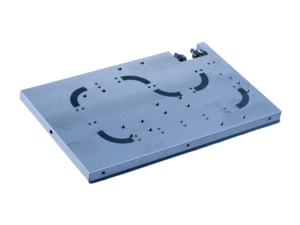
Cooling channels are milled into an aluminum base body and sealed with a cover plate using friction stir welding. This process joins the parts in the solid state. The low heat input minimizes warpage and ensures flatness and leak-tightness. The channel layout is tailored to the hotspots of IGBT, MOSFET, and SiC modules. Miba designs it using CFD simulation.
About friction stir welded cold plates
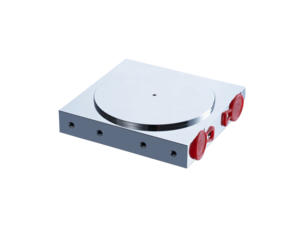
A base plate with integrated cooling structures is brazed to a cover plate in a vacuum furnace using a flux-free process. This creates complex channel geometries that are precisely positioned at the hotspots. This is ideal for high power densities in IGBT, SiC, and battery applications.
About vacuum-brazed cold plates
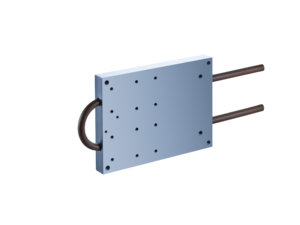
In drilled cold plates, cooling channels are created by drilling holes in the base plate and then connected to form a closed flow path. The channel layout and diameter can be adapted to the thermal requirements of the application. This design is suitable for applications with moderate power requirements for cooling power electronics.
About drilled cold plates
Possible cooling media include water and water-glycol. Depending on the application, deionized or demineralized water may be used.
Miba typically integrates copper or stainless steel tubes into an aluminum base body. The material and design are tailored to the customer's systems.
The pipe routing can be specifically adapted to the location of the thermal hotspots. This allows the cooling medium to be routed close to the semiconductors, so that heat can be absorbed directly at the source.
Tubed cold plates are a suitable alternative when the material and corrosion requirements of the customer’s system can be met through a specific combination of tubing material and base body. A vacuum-brazed or drilled channel structure is not necessary, particularly when the required cooling capacity can be achieved with a tubing layout designed specifically for the application.
Therefore, the material specifications of the customer’s system, as well as the thermal load, cooling medium, corrosion resistance, permissible pressure drop, and available installation space, are decisive factors in the selection process.
