The performance of a heat sink is largely determined by the joining process used in its manufacture. Vacuum brazing (VBA), Controlled Atmosphere Brazing (CAB), Friction Stir Welding (FSW) and Laser welding differ significantly in terms of thermal performance, mechanical strength and long-term reliability.
This article:

The joining process directly determines how efficiently heat is transferred, how high the mechanical load capacity is, and how reliably the heat sink functions in continuous operation.
The reason for this is that the actual thermal performance is not only determined by the material and geometry, but also by the connection between the base plate and the cover.
This is precisely where the processes used in heat sink manufacturing differ fundamentally.
The following four methods are currently used in industrial applications, but differ in terms of design, performance, and application limits.
The comparison shows how the technologies used in heat sink manufacturing differ in terms of thermal performance, mechanical stability, process cleanliness and suitability for high-performance applications.
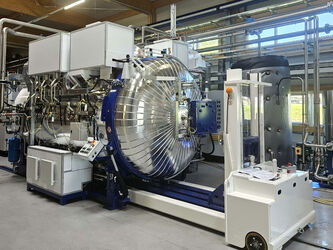
Functional principle
In vacuum brazing, the base plate and cover of the heat sink are joined together in a high-vacuum furnace. The solder melts at temperatures of around 580 to 610 °C and bonds the components metallically without the use of fluxes. The connection is created under vacuum, which reliably prevents oxidation.
Type of connection
Vacuum brazing creates a full-surface, homogeneous connection between the components. Cooling channels are completely closed all around, and the connection is additionally secured at the edges by a brazing seam. This creates a continuous metallic contact surface across the entire heat sink geometry.
Thermal performance
Due to the full-surface connection, vacuum brazing offers the lowest thermal transition resistance of all the processes considered in heat sink manufacturing. Heat is transferred evenly and efficiently from the semiconductor to the cooling medium. Temperature peaks and local hot spots are minimized.
Mechanical properties and compressive strength
Vacuum-brazed heat sinks have extremely high mechanical stability. Depending on the design and channel structure, operating pressures of over 250 bar can be achieved. This ensures that the coolers reliably meet all flatness requirements and prevent mechanical stress on mounted semiconductors.
Typical applications
Vacuum brazing for heat sink manufacturing is suitable for applications with the most demanding requirements. Typical applications include heat sinks for power electronics in energy transmission, particularly in HVDC systems, as well as industrial high-performance applications with high continuous loads.
Limitations
The process requires precise pre-machining and exact fits of the components. The manufacturing process is technically demanding, but offers maximum reliability, long-term stability and reproducible quality.
Functional principle
CAB brazing (Controlled Atmosphere Brazing) takes place in a furnace under a protective gas atmosphere, usually nitrogen. A flux is used to remove oxide layers on the aluminum and enable the solder to wet the surface. The brazing process takes place at temperatures of around 600 to 650 °C.
Type of joint
As with vacuum brazing, CAB brazing also creates a flat joint between the base plate and the cover. However, the quality of this joint is more dependent on process parameters, component tolerances and the even distribution of the flux.
Thermal performance
Thermal performance is generally good, but lower than that of vacuum-soldered heat sinks. Flux residues may remain after manufacturing, which can promote corrosion and thus affect long-term reliability. Less homogeneous solder zones can locally impair thermal transfer and affect temperature distribution.
Mechanical properties and compressive strength
Heat sinks manufactured using CAB soldering achieve high mechanical strength, but this depends more on the design and process stability.
Typical applications
CAB soldering is used for the manufacture of standardized heat sinks with moderate thermal requirements, where economical series production is the main focus. The process is suitable for simple geometries without extreme requirements for compressive strength or cleanliness.
Limitations
The use of fluxes affects cleanliness and long-term reliability. Residues can promote corrosion and are critical in particularly demanding applications.
Functional principle
Friction stir welding is a mechanical welding process in which a rotating tool is guided along the joint. Friction generates heat, which plasticizes the aluminum below its melting point, allowing the components to be mixed together and thus joined.
Type of connection
In contrast to soldering processes, FSW produces a linear weld seam along the joint. The connection is locally limited and does not cover the entire surface. Cooling channels are closed by a cover that is joined using the welding process.
Thermal performance
The thermal performance of this type of manufacturing is lower than that of fully soldered heat sinks, as heat transfer primarily occurs via the base material. The lack of full-surface metallic contact increases the thermal transfer resistance compared to vacuum soldering and CAB soldering.
Mechanical properties and compressive strength
FSW joints exhibit high strength. However, compressive strength is limited by the seam geometry and is lower than that of vacuum-brazed heat sinks, especially in complex channel structures.
Typical applications
FSW is suitable for manufacturing mechanically robust heat sinks with simple channel structures and moderate power requirements. Typical areas of application include industrial applications, the railway industry and applications in the field of renewable energies, such as in wind and solar systems or in selected HVDC components.
Limitations
This method of heat sink manufacturing is only suitable to a limited extent for high-performance applications with high continuous loads or extreme pressure requirements.
Functional Principle
In laser welding, the components are melted locally by a highly focused laser beam and welded together. The process is carried out with very high energy density and a short exposure time, which means that the heat-affected zone remains comparatively small.
Type of joint
Laser welding produces a narrow, locally limited weld seam along the joint. The joint is not flat, but concentrated on the seam area that closes the cooling channels.
Thermal performance
Locally, heat transfer can be very good, but overall thermal performance is limited because there is no full-surface metallic contact between the base plate and the cover. Compared to vacuum-brazed heat sinks, the thermal contact resistance is higher.
Mechanical properties and compressive strength
The mechanical strength of the weld seam is high, but the compressive strength of the overall heat sink is limited by the narrow seam. With high continuous loads or pressure peaks, the risk of local stresses increases.
Typical applications
Laser welding is used to manufacture compact, cost-optimized heat sinks with clearly defined load profiles. The high process speed and precision are advantages for lower thermal and mechanical requirements.
Limitations
The process is only suitable to a limited extent for high-power and HVDC applications due to the limited surface area of the joint.
| Vacuum Brazing | CAB Brazing | Friction Stir Welding | Laser Welding | |
| Atmosphere | High vacuum | Protective gas | None | Protective gas |
| Flux | No | Yes | No | No |
| Temperature range | 580–610 °C | 600–650 °C | Below the melting point | Above the melting point |
| Oxidation protection | Vacuum | Protective gas and flux | None | Protective gas |
| Cleanliness | Very high | Flux residues possible | High | High |
| Brazing or joining gap | Exact fit required | Tolerant | Tolerant | Exact fit required |
| Material diversity | Various aluminum alloys | Various aluminum alloys | Various aluminum alloys | Various aluminum alloys |
| Environmental aspects | Environmentally friendly | Flux pollutes the environment | Environmentally friendly | Environmentally friendly |
| Connection / Joint layer | Full-surface, homogeneous contact | Full-surface contact | Wide weld seam | Narrow weld seam |
| Burst pressure (depending on the flow field) | High (> 250 bar) | High | Low | Low |
HVDC systems place particularly high demands on heat sinks. They operate under high electrical and thermal continuous loads, often for decades. Thermal efficiency, mechanical stability, compressive strength and long-term reliability are therefore crucial.
A direct comparison of the processes used in heat sink manufacturing shows that
While each of the four processes may be the right choice depending on the application, there is no alternative to vacuum brazing for high-performance applications such as HVDC. For HVDC applications, vacuum brazing is the most technically suitable joining process in heat sink manufacturing.
Our experts will help you evaluate the right method for heat sink manufacturing, from technical feasibility to series production.
Talk to us about your project.
