In high-performance power electronics, heat must be reliably dissipated. At the same time, installation space, power density, pressure loss and the arrangement of electronic components place varying demands on the cooling system.
Vacuum-brazed cold plates offer a decisive advantage here: They allow for a high degree of design flexibility when configuring the internal cooling structure.
In this article, you’ll learn:
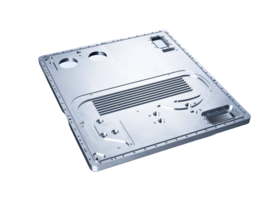
A cold plate is a liquid-cooled heat sink onto which, for example, power electronics components are mounted. Inside the cold plate, a cooling medium flows through defined channels and absorbs the heat generated. This liquid is usually deionized water or a mixture of water and glycol.
The challenge here is not merely to dissipate heat. It is crucial to design the cooling structure to suit the specific application. Vacuum brazing opens up additional design possibilities for this purpose. The quality of the solution depends on how precisely the cold plate is tailored to the specific application.
IGBTs, power modules, and other electronic components generate heat during operation. If this heat is not adequately dissipated, high local temperatures can develop, impairing the components’ performance and service life.
A well-designed cold plate should therefore help ensure that the components remain within their specified temperature limits under the respective operating conditions.
Several parameters interact in this process, such as:
Consequently, there is no single “optimal” cold plate for every application. The cooling structure must be tailored to the specific system.

Vacuum brazing enables more complex cooling structures and thus offers a high degree of freedom in the design of a cold plate.
This allows, for example, cooling channels and structures to be designed to specifically meet the thermal requirements of a component.
The advantage, therefore, lies not only in vacuum brazing itself, but in the possibilities this technology opens up for the design of the cold plate.

Which channel geometry is suitable? How is the temperature distributed? What pressure loss can be expected?
These questions should be addressed as early as possible in the development process.
Miba Cooling uses simulation technologies that allow thermal behavior and sizing to be analyzed during the development phase.
Simulation does not replace subsequent validation. However, it helps compare variants early on, make more informed technical decisions, and reduce development iterations in a targeted manner.
Learn more about our capabilities in the areas of simulation, validation and series production of heat sinks.
Simulation and Validation Blog

The design developed in the simulation is then tested under defined conditions.
Depending on the application, factors such as thermal behavior, pressure loss, leak tightness, and the interaction between the cold plate and power electronics are examined.
Miba Cooling has its own in-house testing capabilities for this purpose, including an IGBT test bench. This allows cooling solutions to be validated in a targeted manner and the results from simulation and design to be verified.
Simulation and validation are directly interlinked and form the basis for further development through to series production.
A cold plate designed for a specific application dissipates heat in a targeted manner and helps ensure that defined temperature limits are maintained. Depending on the application and operating conditions, it thus creates important conditions for:
The key to this is proper design: the cooling structure, channel geometry, and flow path must be specifically tailored to the thermal requirements of the respective application.
Which cold plate is right for your application?
Our experts are here to help you with advice and support!
